Achieving the degree of uniformity required by the process while reducing concentration and temperature gradients caused by dosing, mass transfer, reaction, or heat transfer. Low-viscosity liquids can often be homogenized relatively quickly, while high-viscosity media may require close-clearance impellers to establish effective circulation.
Selection Considerations
Viscosity / rheology
Vessel geometry
Power input and scale-up
High-Viscosity Mixing
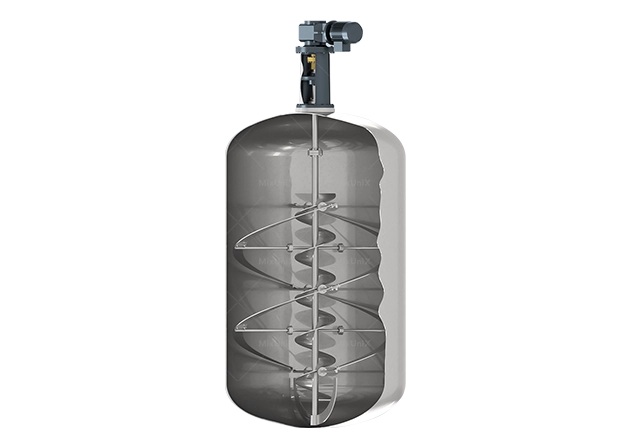
Mixing high-viscosity, non-Newtonian, and paste-like products. Poor flow and difficult heat transfer often require close-clearance impellers such as ribbon, screw, and anchor-frame designs to promote bulk circulation and wall renewal.
Selection Considerations
Viscosity range and rheology
Heat-transfer demand
Wall renewal and dead-zone control
Heat Transfer
Mixing supports heat transfer by promoting bulk circulation and renewal at heat-transfer surfaces, helping control product temperature during exothermic or endothermic reactions and heat or cool the product to a target temperature within the required time.
Selection Considerations
Viscosity / rheology of the medium
Steady or unsteady process
Sufficient heat-transfer area, especially in scale-up
Crystal Quality Control
We control supersaturation and suspension to achieve the desired crystal size distribution and crystal habit. Shear intensity and flow uniformity directly affect nucleation and crystal growth.
Selection Considerations
Target size distribution and habit
Supersaturation control
Avoid crystal breakage
Solid-Liquid Suspension
Solid particles are kept suspended in a liquid at the suspension level required by the process. For some dissolution duties, keeping particles off the bottom and in motion may be sufficient, while continuous processes such as crystallization or leaching often require a more uniform solids distribution.
Selection Considerations
Off-bottom or uniform suspension
Density difference
Particle size
Liquid-Liquid Dispersion
Mixing and dispersing two or more immiscible liquids. In chemicals this is often temporary mixing for extraction or reaction; in pharmaceuticals, cosmetics and food a long-term stable emulsion is required.
Selection Considerations
Temporary or stable emulsion
Density difference / interfacial tension
Input energy
Gas-Liquid Dispersion
Dispersing gas throughout a liquid to increase gas-liquid interfacial area and improve mass transfer. Gas-sparged stirred reactors are widely used in chemical synthesis such as hydrogenation and oxidation, as well as in fermentation.
Selection Considerations
Gas flow rate, operating pressure, and gas-introduction method
Required gas-liquid mass-transfer performance
Liquid viscosity, surface tension, and foaming tendency